
Ryujin
龍神
The dragon god of water and the sea, who brings rain and rules the waves. Ryujin lives in the Dragon Palace (Ryugu-jo) beneath the sea and owns the jewels that raise and lower the tides.

Susanoo
須佐之男命
The tempestuous younger brother of the sun goddess Amaterasu. Known for his wild behaviour, he was banished from heaven, then in Izumo slew the eight-headed serpent Yamata no Orochi and found the sacred sword Kusanagi.

Amaterasu
天照大御神
The sun goddess and the highest deity in the myths of the Kojiki and Nihon Shoki. Born from Izanagi's left eye in the Kojiki's telling, she rules the heavens and is the divine ancestor of the Japanese imperial family. When her brother Susanoo's outrages drove her to hide in a cave, the world was plunged into darkness.

Raijin
雷神
The god of lightning, thunder, and storms. Depicted as a fearsome demon-like figure surrounded by drums that he beats to create thunder. Often paired with Fujin, the wind god, as at Kyoto's Sanjusangendo temple.

Inari
稲荷
The kami of rice, agriculture, foxes, fertility, and prosperity. Inari has no single fixed form — pictured as an old man carrying rice, or at Buddhist temples as a deity riding a white fox — and is served by fox messengers (kitsune). One of the most widely worshipped deities in Japan with thousands of shrines.
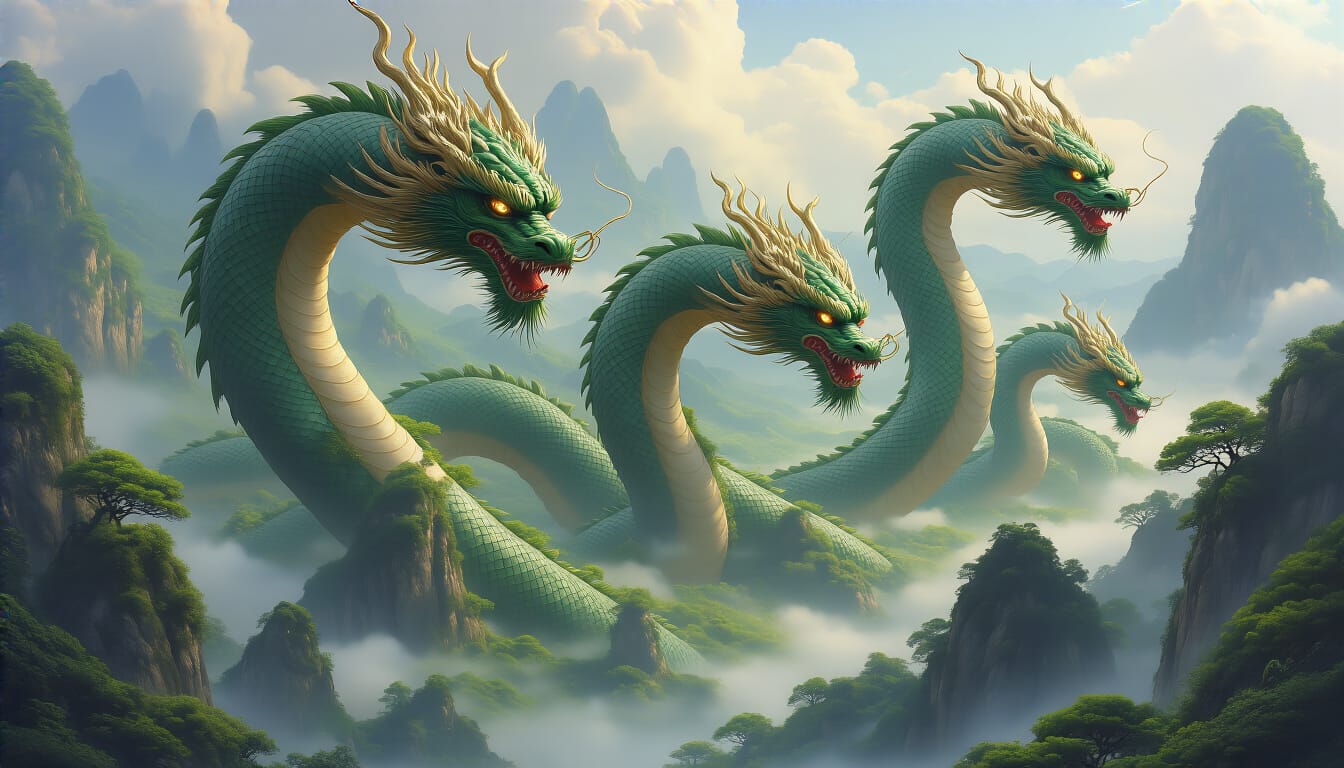
Yamata no Orochi
八岐大蛇
A legendary eight-headed and eight-tailed dragon serpent of enormous size. Its body stretched across eight valleys and eight hills, and it was so massive that moss, cypress and cedar grew on its back. Slain by Susanoo to save Kushinada-hime.

Nue
鵺
A chimera-like yokai with the head of a monkey, body of a tanuki, legs of a tiger, and a snake for a tail. Its eerie cry sounds like the scream of a thrush bird and is considered an omen of misfortune and illness.

Gashadokuro
がしゃどくろ
Giant skeletal spirits formed from the bones of people who died of starvation or in battle without proper burial. Towering many times taller than a human, they roam at night seeking to bite off the heads of travelers.

Yatagarasu
八咫烏
The great crow sent from heaven to guide Emperor Jimmu's army through the mountains from Kumano into Yamato, later pictured with three legs. A divine messenger and symbol of guidance, now used as the symbol of the Japan Football Association.

Nekomata
猫又
Cat yokai with forked tails that have lived so long they gained supernatural powers. They can shapeshift into humans and speak, and folk belief held that a cat passing over a corpse could make the body move. Often depicted as vengeful.

Ushi-oni
牛鬼
An ox-demon of western Japan's coasts, river pools and waterfalls. Descriptions vary: an ox's head on a demon's body in old texts, a demon's head on an ox's body in many local legends. Most tales make it a killer of fishermen and travellers.

Kitsune
狐
Fox spirits renowned for their intelligence, magical abilities, and shape-shifting powers. They can transform into beautiful women and are associated with Inari, the Shinto deity of rice and prosperity.

Kappa
河童
Water-dwelling creatures resembling humanoid turtles with a water-filled dish on their heads. Known for their love of cucumbers and their dangerous habit of challenging humans to wrestling matches or pulling victims underwater.

Tengu
天狗
Mountain-dwelling supernatural beings with both avian and human characteristics. They possess great martial skill and magical powers, and are depicted either red-faced with long noses or with the beak of a crow.

Tanuki
狸
Raccoon dog yokai famous for their jovial nature, shape-shifting abilities, and prominent anatomy. They are often depicted as playful tricksters who use disguises and illusions to fool humans.

Yurei
幽霊
Ghosts of the deceased who remain in the physical world due to powerful emotions or unfinished business. Typically appear in white burial kimono with long, disheveled black hair and no feet.

Oni
鬼
Fearsome demon-like beings with horns, sharp claws, and wild hair. They carry iron clubs and are known for their immense strength and cruel nature. Often depicted with red or blue skin.

Tsukumogami
付喪神
Objects that have acquired spirits after existing for 100 years. They can be tools, household items, or musical instruments that come to life, sometimes benign, sometimes vengeful.

Yuki-onna
雪女
A beautiful woman appearing during snowstorms, with pale skin and long black hair. She can freeze victims with her breath or touch and is associated with death by exposure in snowy mountains.

Noppera-bo
のっぺらぼう
Faceless ghosts that appear as normal humans until they reveal their blank, featureless faces. They enjoy frightening travelers at night but are generally harmless.

Jorogumo
絡新婦
Spider yokai that can transform into a beautiful woman to seduce men. After luring victims, she binds them in her spider silk and devours them. Edo-period tales such as the Taihei Hyakumonogatari tell of spider-women luring travellers to lonely houses and waterfalls.

Rokurokubi
轆轤首
People who appear normal during the day but whose necks stretch to incredible lengths at night. A related type, the nukekubi, can detach its head entirely and send it flying through the night.

Baku
獏
A dream-eating beast with an elephant's trunk, a rhinoceros's eyes, an ox's tail and a tiger's feet on a bear-like body. In Japan it devours nightmares and is a benevolent charm that protects sleepers from bad dreams.

Kuchisake-onna
口裂け女
A tall woman in a surgical mask who stops a lone child on the way home and asks, "Am I pretty?" Whatever the answer, the mask comes down to reveal a mouth slashed from ear to ear, and the question is asked again. Folk wisdom offers escape routes: call her "average", toss her candy, or mutter "pomade" three times.

Hannya
般若
The horned, grimacing face of a woman consumed by jealousy, best known as a Noh theatre mask. Gold-rimmed eyes glare with fury while the brow seems to grieve, so that rage and sorrow share a single face. On stage the mask marks the moment a wronged woman becomes a demon.

Bakeneko
化け猫
An ordinary house cat that has lived too long or tasted something it shouldn't, and quietly become a monster. Bakeneko can walk on their hind legs, speak, take human form, and are said to lick lamp oil in the night. Some simply play tricks; others devour their owners and take their place.

Hanako-san
トイレの花子さん
The ghost of a girl who haunts a school toilet, usually the third stall of a girls' bathroom on the third floor. Knock three times, ask "Hanako-san, are you there?", and a small voice may answer. In some versions a hand pulls you in; in others she is lonely, even kindly.

Tamamo-no-Mae
玉藻前
A courtesan of dazzling beauty and learning who won the heart of a retired emperor, then was unmasked as a fox spirit with nine tails. Driven from the capital, she was hunted down on the plain of Nasu, where her body became a poisonous boulder that killed anything that touched it.

Shuten-doji
酒呑童子
The king of the oni, a giant red demon with a taste for sake and for the young women he carried off from Kyoto to his mountain fortress. The warrior Minamoto no Raikō and his companions reached him disguised as mountain priests, drugged him with magic wine and struck off his head.

Umibozu
海坊主
A vast, black, shaven-headed shape that rises out of a calm sea at night and towers over a boat. Sometimes it simply capsizes the vessel; sometimes it asks for a ladle and starts filling the boat with seawater. The trick, sailors said, is to hand over a ladle with the bottom knocked out.

Seven Lucky Gods
七福神
A cheerful crew of seven deities of good fortune - Ebisu, Daikokuten, Bishamonten, Benzaiten, Fukurokuju, Jurōjin and Hotei - often shown sailing together on a treasure ship. Each has a speciality, from fishing and trade to music, wealth, longevity and contentment.

Raiju
雷獣
The 'thunder beast', a small, fierce animal said to fall from the sky with lightning bolts and leave claw marks on trees and buildings. Descriptions vary widely - a wolf-like creature crackling with electricity, a cat, a weasel - and Edo-period writers recorded live 'raijū' shown in cages and even stuffed specimens.

Kodama
木霊
The spirit that dwells in an old tree. Fell such a tree, and misfortune may follow - which is why ancient trees are often bound with sacred straw rope. The word kodama also means 'echo', the voice that seems to answer back from the forest.

Nure-onna
濡女
A creature with a woman's head and the long body of a great snake, her hair always streaming wet. She appears by the sea and rivers; in western Japan she is paired with the ox-demon ushi-oni.

Fujin
風神
The god of wind, a wild green figure who carries a great bag of air over his shoulders and lets the gales loose across the sky. He is almost always shown alongside his partner Raijin, the thunder god.

Zashiki-warashi
座敷童子
A child spirit, often with a bobbed haircut and a red face, who lives in the inner rooms of an old house. It plays small pranks - footsteps at night, a pillow moved - and as long as it stays, the household prospers. When it leaves, ruin follows.

Futakuchi-onna
二口女
A woman who seems to eat almost nothing, yet hides a second, ravenous mouth in the back of her skull beneath her hair. In the illustrations her hair snakes out to feed it; in the 1841 text the wound speaks and demands food.

Kamaitachi
鎌鼬
A weasel with sickle-sharp claws that rides on whirlwinds and slices the legs of passers-by. The cuts are deep but strangely painless and bloodless. A popular modern retelling has three weasels working as a team; the older Hida tradition speaks of three gods.

Ningyo
人魚
Japan's 'human-fish' is no glamorous mermaid: older accounts describe a fish with a human or monkey-like face, sometimes with a child's cry. Catching one could bring storms or disaster, but eating its flesh was said to grant extraordinary long life.

Tsuchigumo
土蜘蛛
A gigantic earth spider that lurks in caves and ruined mansions, spinning illusions and webs of sickness. In the most famous tale it creeps to the bedside of the ailing warrior Minamoto no Raikō, who wounds it with his sword before it is tracked to its lair and slain.

Kasa-obake
傘おばけ
An old paper umbrella that has sprung to life, hopping about on a single leg, usually pictured today with one big eye and a long lolling tongue. It is more likely to startle and amuse than to harm.

Yamauba
山姥
The old woman of the mountains, with wild white hair and a hungry mouth, who offers lost travellers shelter and then tries to eat them. Yet she can also be generous - rewarding the kind, helping in childbirth, and raising the strong boy Kintarō.

Namazu
鯰
A gigantic catfish living in the mud beneath Japan, whose thrashing causes earthquakes. The god of Kashima Shrine keeps it pinned with a great 'keystone' rock - and when his attention slips, the ground shakes.

Inugami
犬神
A dog spirit that can be sent to possess people and bring sickness, pain or madness. Inugami were believed to be held by certain families, passed down the generations, and to act on their owners' resentments even unbidden.

Amabie
アマビエ
A sea creature with long hair, a beak-like mouth, a scaly body and three fin-like legs, which appeared where a light had been seen in the sea and delivered a prophecy: years of good harvests, then an epidemic. Its advice was simple - copy my picture and show it to people.

Daidarabotchi
ダイダラボッチ
A giant so huge that its footprints became ponds and its handfuls of earth became mountains. In local legend it carried peaks on its back, scooped out lakes, and left hollows across the countryside where it once stepped.

Nurarihyon
滑瓢
An elderly gentleman with a strangely long, bald head, dressed in fine robes. In modern accounts he walks into other people's homes uninvited and helps himself to their tea as if he owned the place. Nobody quite notices him - and nobody can catch him.

Akaname
垢嘗
A wild-haired, clawed creature with a long tongue, pictured by Toriyama Sekien beside a bathhouse. An earlier text says it is born from built-up grime in old bathhouses and lives by licking it. It does no harm, but nobody wants to find it there.

Kiyohime
清姫
A woman (a widow in the earliest version) whose love for a travelling monk turned to fury when he broke his promise and fled. She became a great serpent - in later versions breathing fire and swimming the Hidaka River - and coiled around the temple bell in which he hid until he burned to death inside.